When you present creative work, the typography you choose acts as the frame for your art. Using classic elegance font styles for fabrica portfolio presentations ensures your layout feels refined and intentional without distracting from the actual projects. A well-chosen typeface communicates professionalism and attention to detail before the viewer even reads your case studies.
What defines a classic and elegant typeface?
Elegant typography usually relies on traditional proportions, high contrast between thick and thin strokes, and clean lines. These styles often trace back to historical type design but remain highly relevant in modern digital layouts. For instance, high-contrast serifs like Playfair Display or Bodoni bring a sharp, editorial feel to your headers. For body text, a refined transitional serif like Cormorant Garamond offers excellent readability while maintaining a sophisticated tone.
When should you use traditional typography in your layout?
You want to use these styles when your portfolio focuses on high-end, luxury, or editorial work. If your target clients expect a premium experience, your portfolio needs to reflect that standard. If your portfolio highlights event design, looking into classic pairing strategies for wedding projects can help you match the romantic and formal tone of those specific case studies. The goal is to align the mood of your typography with the mood of the work you are showcasing.
How do you mix serif and sans-serif fonts without cluttering the page?
Mixing type families requires a clear visual hierarchy. Use an elegant serif for your main headings to draw the eye, and pair it with a geometric or neo-grotesque sans-serif for your body copy and captions. This contrast keeps the text easy to read while preserving the high-end aesthetic. Finding the right balance is easier when you study how designers are combining serif and sans-serif typefaces for luxury brands to maintain a clean structure. Keep your font selection limited to two, or at most three, families per presentation.
What are the most common typography mistakes in portfolio design?
Designers often let their enthusiasm for beautiful letters override basic usability. Here are a few errors that ruin an otherwise great presentation:
- Poor contrast: Using light gray text on a white background looks sleek but fails accessibility standards and strains the reader's eyes.
- Tight line height: Squashing lines of body text together makes paragraphs look like intimidating blocks. Give your text room to breathe with a line height of at least 1.5.
- Over-styling: Using all-caps for long paragraphs or adding unnecessary drop shadows distracts from the message.
- Ignoring physical context: This rule applies across mediums, especially when choosing timeless typefaces for packaging design where legibility on physical materials is just as critical as on a digital screen.
How can you refine your typographic hierarchy for case studies?
A strong hierarchy guides the viewer through your project story. Start by establishing clear size jumps between your headings, subheadings, and body text. If your main project title is 48px, your subheadings might be 24px, and your body text 16px or 18px. Use font weight to create distinction rather than just changing the font family. A bold weight for introductory summaries and a regular weight for detailed explanations creates a natural reading rhythm.
Checklist for your next portfolio update
Before you publish your next presentation, run through these practical steps to ensure your typography supports your work:
- Limit your entire portfolio to a maximum of two or three type families.
- Check your body text line height and ensure it is set between 1.4 and 1.6 for optimal readability.
- Verify that your text colors meet WCAG contrast ratios against your background colors.
- Proofread your kerning on large display headings to fix any awkward letter spacing.
- Test your portfolio on a mobile device to confirm your elegant fonts scale down without losing their distinct characteristics.
 Classic Elegance in Wedding Fabrica Font Pairings
 Mastering the Didot and Caslon Pairing for Fabrica
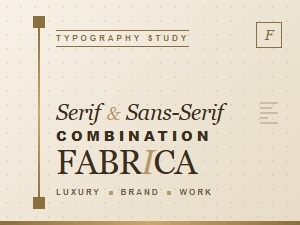 Classic Serif and Sans Serif for Luxury Fabrica Work
 Selecting Timeless Fonts for Luxury Fabric Packaging
 Mastering Bohemian Font Pairings for Handcrafted Projects
 The Essential Guide to Modern Minimalist Font Pairing